
– By Dr Abaigh McKee, Research & Development Manager at Baby Lifeline
Baby Lifeline has recently been working with colleagues at the University of Warwick, Imperial College London, and community organisation Coventry Empowered African Women’s Group (CEAWG) in a participatory research project funded by the University of Warwick. The aim of the project is to understand women’s experiences and offer solutions to improve access to maternity services for Black, African, Caribbean and mixed-Black heritage families.
This blog reflects on the project’s progress so far, the power of collaboration, and five key themes that emerged from the workshops with women.
Reducing inequalities: A national priority
Racial inequities in maternity care in the United Kingdom are well-documented and deeply concerning. Black women and birthing people are more likely to face poor health outcomes, and are three times more likely to die during or shortly after pregnancy than white women; Asian women are twice as likely to die.
People that use health and care services in the UK report experiencing discrimination and racism, lack of trust, and difficulty accessing services. Five X More’s recent Black Maternity Experiences Report found that Black women are still experiencing discrimination, poor communication, not being believed, and a lack of information when accessing maternity services, despite interventions to combat these problems. Though reducing these inequalities is a national priority, evidence-based solutions are less readily available.
Finding solutions together
Co-production and participatory research – involving service users in designing solutions – is widely recognised as an impactful way to find impactful strategies, though it is a relatively new approach in healthcare settings. NHS England guidance states that some of most effective ways for improving population health and tackling health inequalities are “those that work in partnership with their people and communities and local authority colleagues.” Working with communities is also emphasized in the government’s 10 Year Plan Health Plan for England.
Our project aims to do precisely this: bring together service users, community representatives, healthcare professionals and local authority colleagues to identify challenges and offer ideas for improvement through stakeholder workshops.
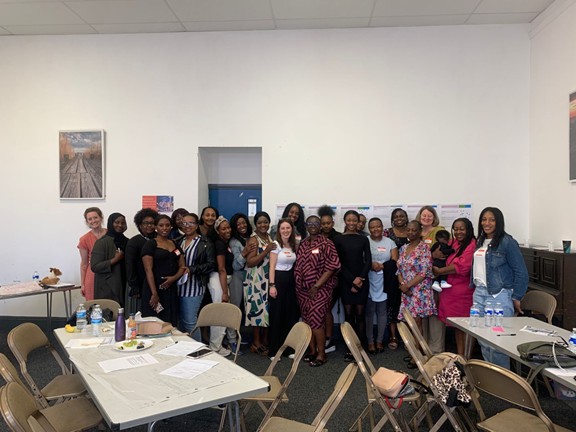

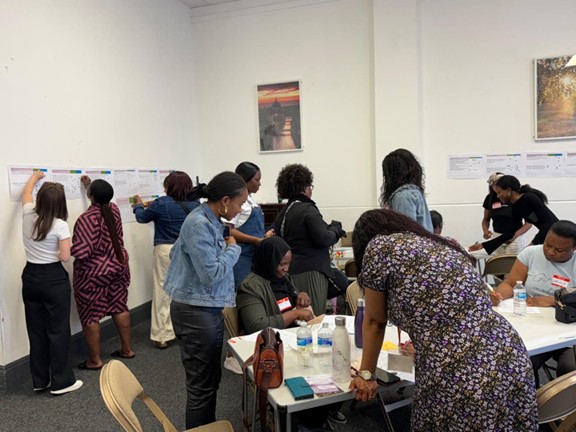
The project brought together service users and stakeholders to identify challenges and co-produce ideas for improvement.
The workshops
We invited women from Black, African, Caribbean and mixed-Black heritage communities to attend three trauma-informed, community-led service-user workshops in Coventry city centre. These workshops were led by the team: Dr Abaigh McKee from Baby Lifeline, Ruth Ngwata from CEAWG, and Dr Abimbola Ayorinde, Mary Van Der Riet and Dr Haliyya Bakare from the University of Warwick.
The project adapted methods from a similar programme in London led by Sarindi Aryasinghe at Imperial College London, using an adapted Nominal Group Technique (NGT) to facilitate discussions. Working in partnership with two community organisers, Sarindi trained lived experience partners on the process, supporting them to deliver the workshops.
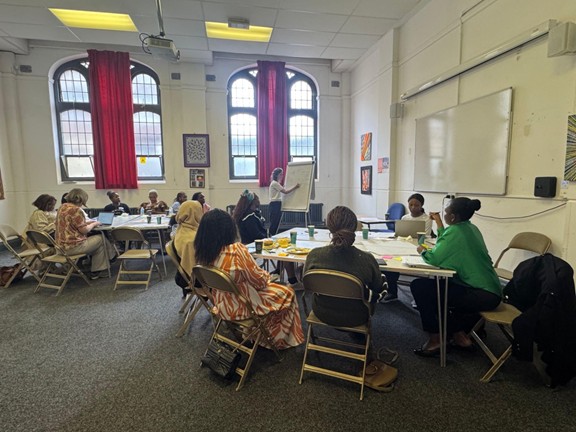
The sessions began with informal conversations between the group participants and facilitators. We then opened a series of discussions, during which participants were invited to share their experience using maternity services. The participants were encouraged to offer ideas and solutions for improvements. At the end of the workshop, participants voted for the ideas they felt would be most effective. We also facilitated similar sessions virtually with healthcare professionals and local authority representatives.
The project culminated in a final in-person workshop where participants from all groups were invited to a joint stakeholder event to discuss the themes that arose from the project. All participants discussed the themes in small groups, and then voted again on the ideas that they thought were most feasible and would be most impactful to their community going forward. This allowed us to identify and prioritise the most popular solutions for improving maternity care experiences and outcomes together.
Key Priorities and Solutions from the Community Workshops
The community participants identified five core themes (outlined below) as priorities for improving maternity care for Black, African, Caribbean, and mixed-Black heritage families. Each theme was paired with practical, community-driven solutions.
Theme 1: Staff Cultural Safety Awareness and Behaviours
Participants shared experiences relating to staff behaviour and attitude, and emphasised the need to reduce prejudice and perceived judgement. Suggested solutions to this included enhancing cultural sensitivity training for healthcare professionals, to include unconscious bias and stereotyping, education around cultural and spiritual practices, and increased empathy. The groups also spoke about equipping staff with materials to support cultural respect (for example by providing disposable foot covers for home visits).
Theme 2: Information and Education
The community workshop participants also highlighted the importance of empowering women and service users with information, particularly in relation to medications and treatment options. They felt that clear, detailed explanations of procedures and care plans would be useful to support informed decision-making.
Theme 3: Increasing Health Service Resources
The community groups were keen to see increased staff, particularly on night shifts. They also wanted recruitment processes to consider cultural sensitivity. The participants were keen for there to be sufficient staff on shift for cultural practices (such as a request for a female doctor) to be respected.
Theme 4: Advocacy
Participants at the community workshops expressed concerns about complaints procedures. They felt that women and birthing people from diverse backgrounds should be informed about complaints procedures and encouraged to make complaints if they were dissatisfied with the care they received. They also wanted to make sure that women had access to advocacy organisations, and that they could seek a second opinion.
Theme 5: Improving Healthcare Professional to Service-User Communication
The final theme that emerged from the workshops related to communication. The community groups wanted to make sure that Black and mixed-heritage women’s voices are heard and respected, in order to build trust and provide person-centred care that reflects individual needs and experiences.
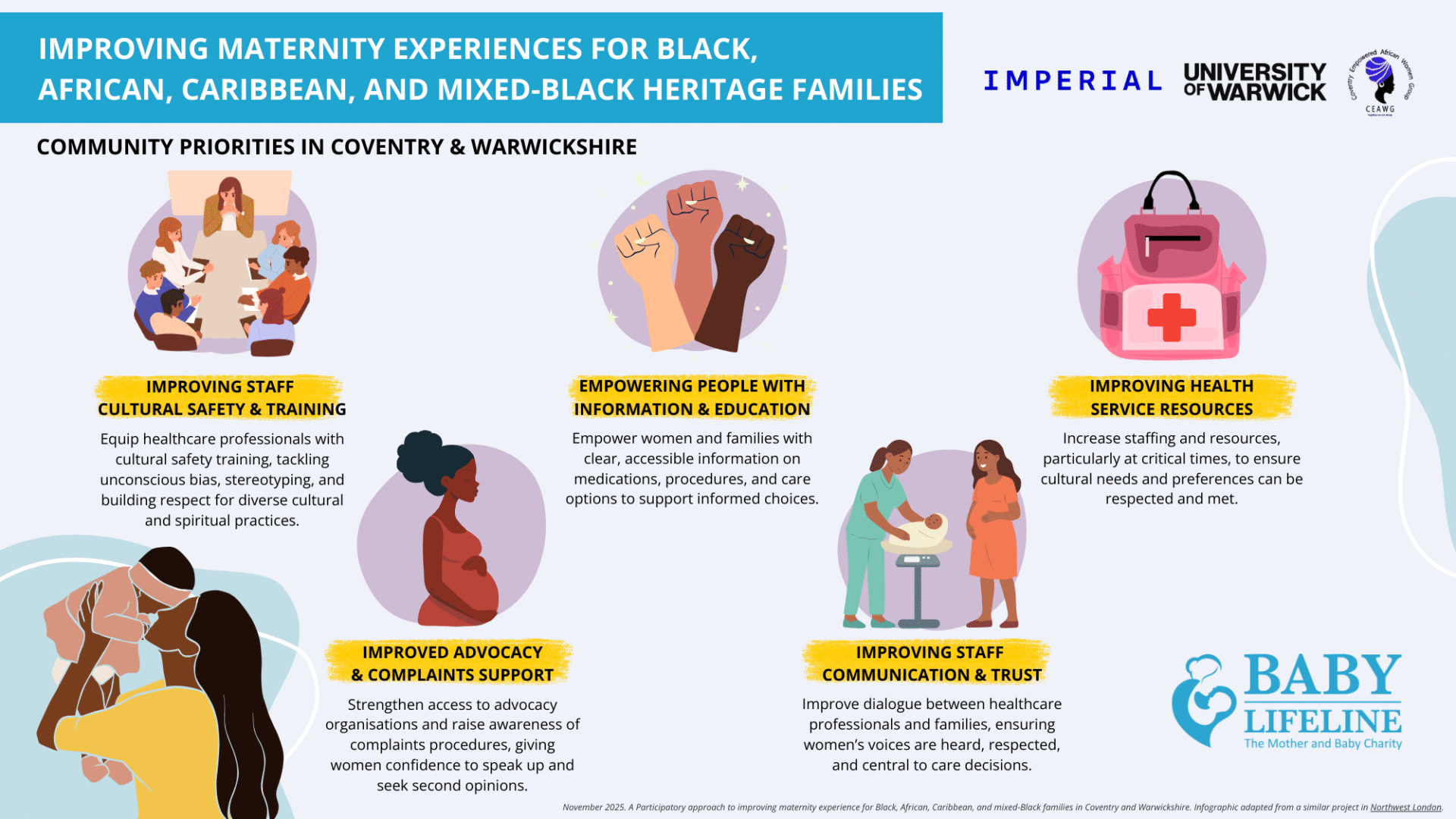
This infographic shows the priorities that emerged from the workshops with lived experience partners. It is adapted from a similar infographic produced by the team in North West London. More info about the North West London project here: Starting our journey: co-producing priorities to improve maternity care.
Next steps
This project demonstrates the potential of participatory research when led with care, respect, and a commitment to equity. By centring the voices of those most affected by maternity care inequities, and fostering collaboration across sectors, we were able to surface priorities that are both meaningful, relevant locally and, in many cases, actionable. These actions may help to improve outcomes for Black, African and mixed-heritage families, and improve psychological safety and job satisfaction for healthcare professionals too.
The next steps for the project will be analysing the results of the other stakeholder workshops, writing up the findings, and creating resources to disseminate the information widely, so that the project may be repeated elsewhere.
As we continue analysing and publishing the findings and working toward implementation, one thing remains clear: real change begins with listening, and lasting change requires shared ownership.
Call to Action
If you are a healthcare professional, policymaker, or advocate – or someone with lived experience – we invite you to join the conversation. Share this blog, reflect on the priorities raised, and consider how you can support culturally safe, person-centred maternity care in your own context.
The women we worked with valued the opportunity to share their experiences. If you are a community organisation, you might consider creating similar spaces for generating ideas and solutions.
About the Author
Dr Abaigh McKee is Research & Development Manager at Baby Lifeline. For this project, she co-led trauma-informed facilitation sessions and is contributing to the ongoing analysis and write-up. This work focuses on amplifying the voices of those most affected by systemic ethnic inequities and co-creating solutions that centre compassion, dignity, and justice.
¹Allison Felker, Roshni Patel, Rohit Kotnis, Sara Kenyon, Marian Knight (Eds.) on behalf of MBRRACE-UK. Saving Lives, Improving Mothers’ Care Compiled Report – Lessons learned to inform maternity care from the UK and Ireland Confidential Enquiries into Maternal Deaths and Morbidity 2020-22. Oxford: National Perinatal Epidemiology Unit, University of Oxford 2024. Available at MBRRACE-UK Maternal MAIN Report 2024 V2.0 ONLINE.pdf. Accessed 1st August 2025.
²Leila Morris and Ruth Robertson. ‘Tackling Health Inequalities: Seven Priorities For The NHS.’ The Kings Fund. 2024. Available at: Tackling Health Inequalities | Seven Priorities For The NHS | The King’s Fund. Accessed 1st August 2025.
³Peter M, Wheeler R, Abe C,Awe A. The Five x More Black Maternity Experiences Survey: Continuing the Conversation on Black Maternal Care in the UK. Five x More. 2025. Available at: Black Maternity Experiences Report 2025 — FIVEXMORE. Accessed 1st August 2025.
⁴HM Government. Fit for the Future: The 10 Year Health Plan for England. Presented to Parliament by the Secretary of State for Health and Social Care by Command of His Majesty. 2025. Available at: https://assets.publishing.service.gov.uk/media/6888a0b1a11f859994409147/fit-for-the-future-10-year-health-plan-for-england.pdf. Accessed 1st August 2025.
⁵NHS England. ‘Working in Partnership with People and Communities: Statutory Guidance.’ 2022. Available at: Working in Partnership with People and Communities. Accessed 1st August 2025; and The Health Creation Alliance and Royal College of General Practitioners. ‘Health Creation: How can Primary Care Networks succeed in reducing health inequalities? Report from a series of multi-stakeholder events held between February and September 2020.’ Available at: Health Creation: How can Primary Care Networks succeed in reducing health inequalities?. Accessed 1st August 2025.
⁶HM Government. Fit for the Future: The 10 Year Health Plan for England. Presented to Parliament by the Secretary of State for Health and Social Care by Command of His Majesty. 2025. Available at: https://assets.publishing.service.gov.uk/media/6888a0b1a11f859994409147/fit-for-the-future-10-year-health-plan-for-england.pdf. Accessed 1st August 2025.
⁷Aryasinghe, S. et al. ‘Improving the maternity experience for Black, African, Caribbean and mixed-Black families in an integrated care system: a multigroup community and interprofessional co-production prioritisation exercise using nominal group technique.’ BMJ Quality & Safety. 34(5): 305-316. Available at: Improving the maternity experience for Black, African, Caribbean and mixed-Black families in an integrated care system: a multigroup community and interprofessional co-production prioritisation exercise using nominal group technique – PubMed. Accessed 1st April 2025.